
March 2022
There is no question that employees’ expectations about work have evolved over the last few years. Environmental pressures such as the COVID-19 pandemic and social movements caused upheavals to nearly all facets of work and personal lives, leading many people to reassess what they need and want from their workplace.
One clear sign of this is what is being called the Great Resignation. Organizations are struggling to retain employees and recruit new talent. In fact, McLean & Company’s 2022 HR Trends Report reveals that while talent acquisition has been the top priority for human resources professionals for several years running, survey respondents expected to spend 25 percent more time on talent acquisition this year than they had previously. This is a massive increase!
So, what should HR teams do to resolve recruitment and retention challenges?
Sadly, there is no quick or one-size-fits-all solution. And organizations that are not able to offer remote work to a large number of workers will find navigating 2022 particularly difficult.
To have a sustainable impact on recruitment, retention and engagement, each organization must implement its own people-centric solutions that allow both employees and the organization to thrive. Doing that starts with articulating and strengthening the organization’s employee value proposition, or EVP.
Revisit the Employee Value Proposition, Perhaps for the First Time
All aspects of the employee experience factor into determining the EVP. For instance, pay and benefits, location, work-life balance and the respect managers show workers are some of the major determinants of an EVP. A strong EVP motivates current employees to stay and convinces candidates to accept job offers.
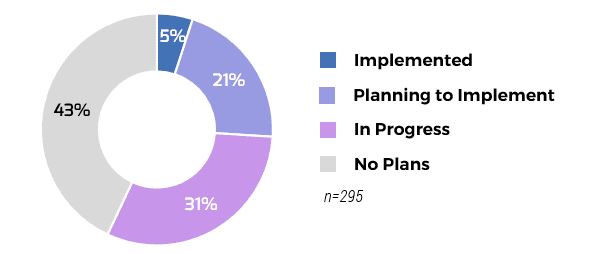
Given the evolution of employees’ expectations, it makes sense for employers to revisit their unique offerings to employees. Despite encountering recruitment and retention pain points, however, many organizations have no plans to write out or update their EVP (see Chart 1). Somewhat going against this trend, organizations capable of offering remote work are 16 percent more likely to revisit their EVP than are their counterparts.
Chart 1. Organizations Revisiting Their Employee Value Proposition in 2022 Due to Changes in the Working Environment and Labor Market
What Are the Elements of a Strong Employee Value Proposition?
It is important that an EVP provides a compelling but realistic view of the benefits of joining the organization. A strong EVP also connects with employees in ways that encourage them to stay. At the intersection of what the organization does well and what employees value is the employees’ voice.
Revisiting the EVP starts with looking at three essential criteria from the employees’ perspective. Most importantly, and as illustrated in Chart 2, the EVP must be:
- Aligned with the organization’s purpose, vision, values, programs and processes;
- Accurate in terms of reflecting the employee experience so it will not be discounted by employees and candidates; and
- Aspirational in that it includes aspects of the organization’s mission and culture that are being actively worked towards if they are not yet fully realized.
Focusing on these characteristics will help with attracting and retaining talent by ensuring that new hires’ expectations are met and that the EVP is felt throughout the organization.
In a labor market as competitive as the one we are currently experiencing, having an EVP that appeals only to current employees will not suffice. To give an organization an advantage, the EVP also needs to be:
- Compelling in terms of both emphasizing the value created for employees and motivating candidates to join the organization;
- Clear, straightforward and easy to understand; and
- Comprehensive in the sense that it provides enough information to describe the employee experience to allow candidates to self-assess if they are a good fit.
Chart 2. Elements of an Employee Value Proposition That Retain Employees and Attract Candidates
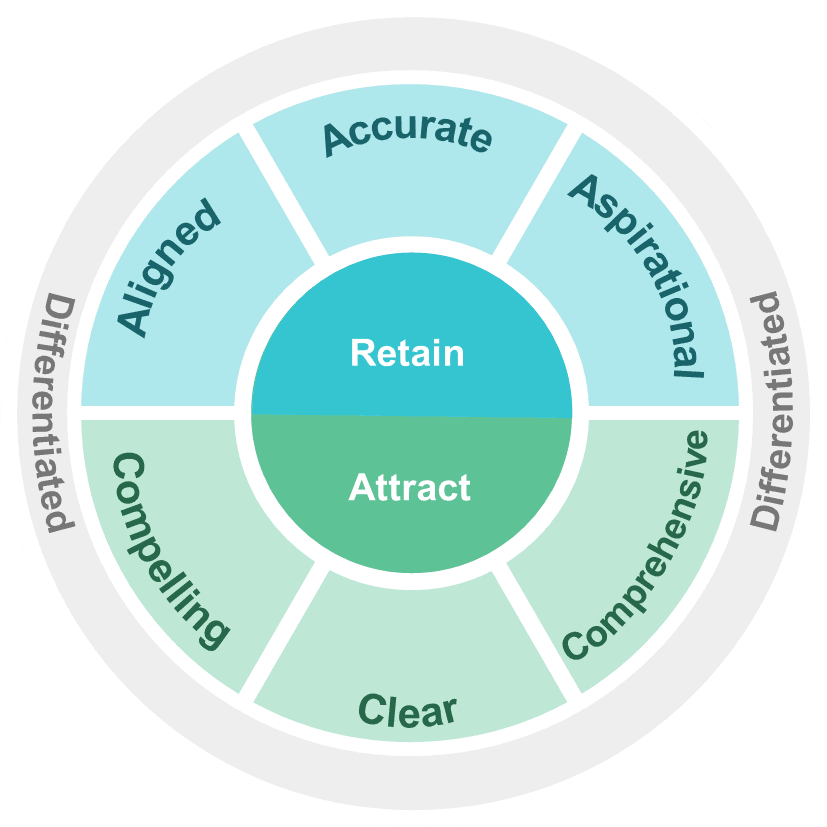
Over and above these internal and external criteria, it is crucial that the EVP is differentiated from the organization’s labor market competitors. After all, existing employees and potential candidates have a lot of options at a time when unemployment in the United States is near a historic low and new remote work opportunities seem to appear each day. To improve recruitment and retention, it is important to highlight the unique aspects of the organization’s culture, programs and policies that will appeal to workers in the targeted talent pool.
Seek Out and Heed Employees’ Voices
One of the biggest mistakes organizations make when articulating and updating their EVP is relying solely on feedback from leaders. As a result, the EVP fails to capture the lived experiences of other employees and does not reflect what a great many employees truly value.
Employees are not a homogenous group, especially at an organization with a diverse workforce. Each worker has different experiences and values. These realities make it essential for those charged with revisiting the EVP to take the time to gather input from as many employees as possible throughout the entire process. In fact, gathering input from employees on what they value and what keeps them at the organization may reveal that developing a single EVP for the entire organization does not make sense. Customizing EVPs for different units or worksites could deliver the greatest benefits.
Many organizations already have data that indicate what employees value. For example, results from annual or biannual employee engagement surveys, pulse surveys and a targeted employee Net Promoter survey will all provide key insights. Organizations can also use new hire surveys, stay interviews, and exit interviews or exit surveys to collect key data.
One more great way to gather feedback and ensure the EVP is accurate and aspirational is to hold employee focus groups. Be sure to include employees from all departments and of all demographics. Admittedly, holding focus groups can be time-consuming. But the effort is well worth it when the goal is developing an EVP that both increases retention and improves recruitment.
It is also important to solicit employees’ input once an EVP statement is drafted. Asking employees what they think at this stage will help to ensure the EVP resonates with employees and that key aspects of what employees previously said they value did not get lost as the draft went through iterations.
Publishing an Employee Value Proposition Statement Is Not Enough
A critical step in developing and implementing an EVP is working with HR leaders to identify areas where the EVP and HR programs and policies are misaligned. For example, one element of the EVP may state, “We are committed to work-life balance.” When existing flexible work policies and programs are unclear or inconsistently administered, employees’ ability to achieve the promised work-life balance could be compromised.
Which is to say actions speak louder than words. Without aligning HR programs and policies, the EVP will be an empty statement that may do more harm than good. Unkept and broken promises exacerbate retention and recruitment challenges.
When issuing the updated EVP, make sure to create feedback loops to enable the ongoing evaluation and revision of the EVP. As with all significant initiatives, following a carefully designed communication and change management plan will be key to succeeding with the EVP.


