
October 2020
Have you ever witnessed a colleague fail to speak up when they should have? Did they hesitate to offer comments or suggest a new idea because they feared how their manager or others would react? Did they expect to face reprisals for raising concerns?
Do you recognize yourself as the colleague who remained silent?
You are not alone. The reality is that it’s not always safe to speak up at work.
In its 2017 State of the American Workplace, Gallup reported that just three in 10 employees agreed with the statement that their “opinions seem to count” at work. The polling firm went on to note that if the response rate rose to six in 10 employees, organizations could realize a 27 percent reduction in turnover, a 40 percent reduction in safety incidents and a 12 percent increase in productivity.
Clearly, how safe people feel at work determines many organizational outcomes. When employees feel psychologically safe, they take risks without fearing adverse consequences when an experiment does not pan out. Psychologically safe employees are also more likely to express themselves without worrying about retribution. On the opposite end of the spectrum, employees feel too intimidated to share insights and ideas when they do not feel safe. Hence, engagement goes down.
A considerable body of research shows that the degree of psychological safety employees feel is related to the amount of emotional intelligence (EI) their managers and team members display. Coworkers’ EI also influences an employee’s ability to handle stress.
When EI is high across a workforce, team members find it easier to navigate work processes and the workplace. Employees will enjoy their work more, be better able to form close relationships and do better when faced with challenges—even serious one like the coronavirus pandemic. Organizations where EI is low are likely to have employees who are struggling to cope with longer hours or with being at home with little variation in routines while taking care of themselves and their families.
What Is Emotional Intelligence?
The concept of EI grew out of the understanding that how people behave and express themselves matters for how others respond to them. In operational terms, EI is the ability to identify and understand one’s own emotions, as well as the ability to regulate one’s emotions in positive ways to relieve stress and to communicate and empathize with others in ways that build productive relationships.
Another way to think about EI is as a set of personal competencies for recognizing what triggers specific emotions and for acknowledging how others perceive and react to your emotional states. Developing a high EI requires cultivating tools for regulating your emotional responses and outward expressions of internal reactions. Low EI makes it difficult to build and sustain relationships.
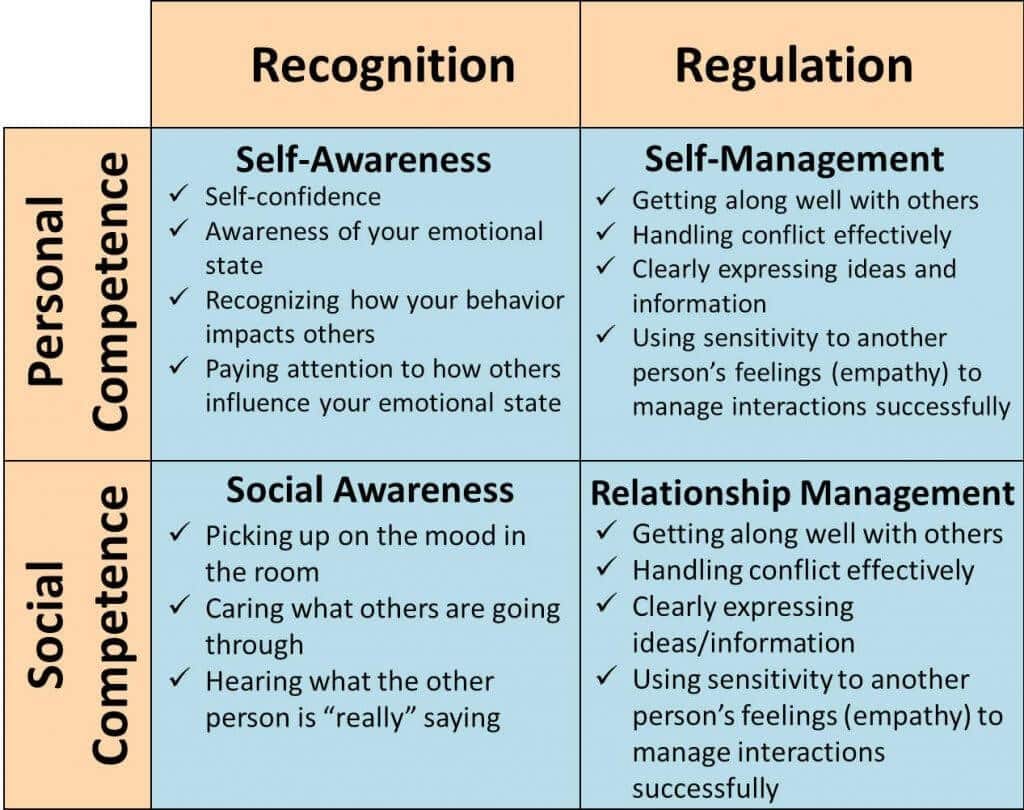
EI is generally described as having four components.
The Components of Emotional Intelligence
Self-Awareness
Being self-aware involves being confident in your ability to read your own emotions, to understand what drives your moods and to recognize the impact your emotions and moods have on other people. Being self-aware also involves knowing your strengths and limitations when it comes to monitoring your emotions and moods. When you are self-aware, how you go through the world becomes less about what others are doing to you and more about what you think and feel as things happen.
As you develop your self-awareness, you become cognizant of the words you use to describe your feelings, as well as how other people interpret the meanings of those words. Once you have strong self-awareness, you will also be able to articulate what triggers negative emotions and bad moods. Identifying your hot buttons allows you to work on not responding automatically or impulsively, which means you can work on not increasing tensions.
Self-Management
Practicing self-management involves framing your reactions to emotional triggers in ways that allow you to create solutions. Self-management competencies include having a sense of achievement, being able to keep disruptive emotions under control and displaying honesty, integrity and trustworthiness.
Social Awareness
Showing social awareness involves being able to sense other people’s emotions, understanding others’ unique perspectives and learning to take an active interest in things others are concerned about. It also involves having organizational awareness.
Relationship Management
In our social world, we are constantly making connections—or not—with those around us. Managing relationships well allows you to motivate, lead and guide others by tuning in when they speak, coaching them, offering feedback and deescalating conflicts. This relates to self-awareness because managing relationships becomes possible when you are conscious of how you are showing up and what impact you are having on others.
Why Emotional Intelligence Is so Important in the Workplace
Stated plainly, EI is a business imperative. It is a basic tool that, deployed with finesse, is the key that unlocks professional success.
To see why EI is not a mere luxury that you can dispense with when times get tough, think about the best and worst bosses you ever had. Write down three attributes or characteristics that describe each person’s behavior.
What made the two bosses different? What impacts did their actions and words have on you, the team and the organization’s performance? Now, ask yourself who you would prefer to work with or for again. Who do you want to emulate?
Researchers who study EI and organizational performance would tell you that one reason you appreciated your good boss was because that person made you feel psychologically safe. When individuals feel threatened and at risk, they turn away. Conversely, individuals who feel safe reach out to others.
We know that, on average, the best organizations do not succeed because they employ a few standouts. The best organizations become the best because their employees form great teams, work together and feel engaged.
To perform at a high level, however, employees must first feel psychologically safe and trust each other. A commonly accepted definition of psychological safety is
An individual’s perception of the consequences of taking an interpersonal risk or a belief that a team is safe for risk taking in the face of being seen as ignorant, incompetent, negative or disruptive. In a team with high psychological safety, teammates feel safe to take risks around their team members. They feel confident that no one on the team will embarrass or punish anyone else for admitting a mistake, asking a question or offering a new idea.
And this is where EI proves its worth. Emotions are a primal force. They are the first response people have when they interact with others. On teams, how emotions are displayed and expressed make members feel either safe to take risks or fearful of attempting to contribute. Hence, leaders and members of great teams need to be able to identify, understand and manage emotions.
Team members who are self-aware and who can manage their emotions develop the skills they need to handle other members’ behaviors effectively and to respond in supportive or constructive ways when they hear ideas different from their own. Team members will then increase their ability to become socially aware of each other by picking up visual and verbal cues. This increases their ability to feel and show empathy for each other, which builds relationships and increases commitment to achieving shared outcomes. Establishing good working relationships also makes it easier to resolve conflicts.
If you are a team leader, a substantial part of your job is to listen more, talk less, praise generously, reframe negative feedback and pay attention to the impact of your behavior. Honing your EI allows you to set the tone. As Daniel Goleman wrote in Emotional Intelligence. “The rules for work are changing. We’re being judged by a new yardstick: not just by how smart we are, or by our training and expertise, but also by how well we handle ourselves and each other.”
Can I Develop My Emotional Intelligence?
Yes, absolutely. And managers and team members who do so create psychological safety within their workgroups. This, in turn, creates an environment in which employees stay engaged and productivity remains high.
Start increasing your EI by thinking about your thinking. You will always experience positive and negative emotions. Reflecting on those immediate responses points the way toward building resiliency, improving your ability to see challenges and experiences from different perspectives, helping you bank psychological capital and keeping you grounded.
For the purposes of increasing your EI, negative emotions can serve you better than positive ones. Processed correctly, negative emotions help you identify legitimate threats to your well-being (as opposed to mild annoyances or inconveniences). They also highlight the issues that you need to address in order to improve circumstances and outcomes for yourself and the people around you.
A reality that holds many of us back from adequately assessing and managing our emotions is that we use a limited emotional vocabulary. We tend to stick to basic descriptions such as sad, angry, anxious, depressed and stressed. But research shows that people who can differentiate and name a wider range of emotions do better at managing (i.e., self-regulating) their expressions and behaviors. This makes these individuals more able to lower their stress and adapt to change.
The Mood Meter displays a host of words that matter.
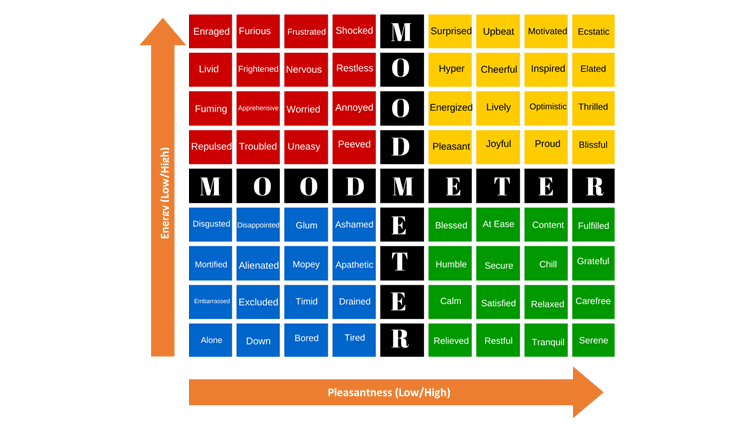
Here is an exercise you can try. The next time you are troubled or upset about something, describe those feelings to yourself and take note of how much energy the emotion inspires. Rate the degree to which the feeling was pleasant or unpleasant. Now, consult the Mood Meter. Find the word that best matches what you just went through.
Gaining clarity about your emotional responses enables self-management. When you ascribe the proper meaning to your reactions, you should find it easier to develop resilient practices.


