
August 2020
A massive modernization project underway at the Illinois Municipal Retirement Fund (IMRF) created the perfect opportunity to introduce new organizational change management (OCM) strategies that focused on the people side of the project. IMRF’s Horizon Project, as it has been named, is a multimillion-dollar undertaking that heavily impacts all areas of the fund’s business. Employing OCM strategies set the stage for transitioning to an environment in which staff are engaged and excited about the improvements the Horizon Project will bring.
IMRF Commits to Making a Major Change
IMRF is the second-largest and best-funded public pension fund in Illinois. The fund administers retirement, death and disability benefits for more than 3,000 units of local government in Illinois and, at the end of 2019, held approximately $44.8 billion in assets. And, as reported in the March 2020 HR News, IMRF is the first public pension fund in the United States to receive the Malcolm Baldrige National Quality Award for performance excellence.
Although IMRF’s products are regulated by state law, our services are open to innovation, and we pride ourselves on being innovators who are committed to continuous improvement. Acting on this commitment, the fund undertook an ongoing project to replace its custom-built legacy mainframe computer system with commercial off-the-shelf (COTS) hardware and software. The legacy system has been in use for almost three decades, growing more customized each year.
This major modernization project affects every aspect of the business, from multiple call centers and a mail center to application processing units, a financial unit and all self-service capabilities for members and employers. These core business units work with millions of data records that interact with each other in many different systems.
In addition to transitioning away from the mainframe system, the Horizon Project encompasses efforts to restructure and improve our customer relationship management, enterprise content management, web self-service and content management systems. We are moving, through numerous steps and phases, from a place of expertise to one of continual evolution.
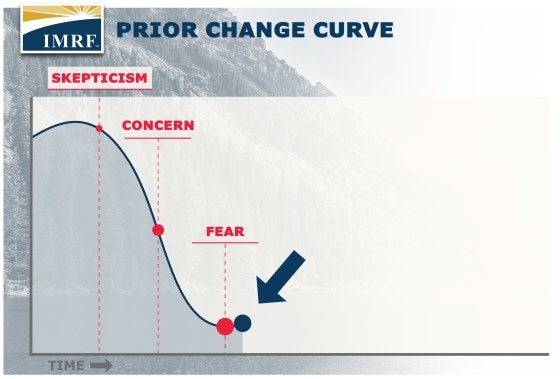
If you envision change as a process represented by the Kübler-Ross Change Curve, after a period of time, many of our team members found themselves at the low-point of the curve (see Figure 1). They were in the Fear stage and growing increasingly wary.
“With all this change, IMRF staff understandably began experiencing increased levels of anxiety and uncertainty,” said Cara Bannon, IMRF director of human resources. “This is a natural response to any big change, and we knew that IMRF needed to take some proactive steps to help the team advance along the change curve as quickly as possible.”
IMRF looked to the Baldrige Criteria for Performance Excellence for answers on helping employees embrace change. The fund had followed the Baldrige criteria for more than a decade, so we took a close look at the change management piece for guidance. Here is a brief look at what the criteria say about change management:
Section 5.1 Workforce Environment
Change managementChange management is a process that involves transformational organizational change controlled and sustained by leaders. It requires dedication, involvement of employees at all levels, and constant communication. Transformational change is strategy-driven and stems from the top of the organization. Its origin may be identified within the organization, and it requires the active engagement of the whole organization.
How We Managed Change Processes
With Baldrige guiding us, IMRF implemented a number of new OCM strategies to build momentum and move our team forward along the change curve.
Organizational Restructuring
One foundational improvement we made was adding HR staff to the Horizon Project management team to help plan and administer the OCM piece of the project. HR staff, in conjunction with senior management, developed a clear and comprehensive OCM plan. Also, as communication efforts moved to the forefront of the project and became a key piece of the OCM plan, IMRF moved the communications team under the management of the director of human resources to strengthen this partnership and underscore IMRF’s commitment to OCM.
Focusing on Communication
To make sure we were effectively communicating with staff, answering their questions and addressing their concerns, IMRF began holding town halls twice per year. We also started producing a quarterly newsletter titled Horizon Brief to report on high-level project news and deliver strategic messages. That supplemented emails from project leaders to core team members and our weekly staff email newsletter, IMRF Update, which shared additional project updates in between the quarterly briefs.
“The way to have a successful project is to focus on the people involved,” said Julia Taylor-Young, IMRF organizational development lead. “You need to answer the ‘what’ and the ‘why’ and connect the dots for staff in order for them to become invested in the project.”
Asking for Staff Feedback
IMRF realized its project communication process needed to be two-way if it were to foster engagement and identify improvements. The fund needed to go beyond pushing messages out to staff. We also needed to provide team members a mechanism to provide feedback on how they felt the project was progressing.
IMRF introduced what we called quarterly “pulse surveys.” These check-ins were sent to any team members who was directly involved in supporting the project. They were designed to be short and focused in order to quickly and easily take the pulse of the project.
Completing each survey required only a few minutes, with staff being asked straightforward questions like whether staff members were excited about the new Horizon tools and whether they felt like they were making important contributions to the project’s success. The feedback often confirmed all was well, but responses also provided ideas for improvement. For example, after receiving feedback from staff, IMRF implemented weekly cross-functional meetings that opened avenues for collaboration between groups that had been isolated from each other.
Setting Expectations and Empowering ‘Change Champions’
One of the most effective strategies IMRF employed was precisely defining 18 characteristics and behaviors expected of all Horizon Project participants. The list included attributes such as enthusiasm, agility, openness, fearlessness, trust in other departments and displaying a collaborative attitude. IMRF communicated these expectations to every Horizon Project core team member and each IMRF leader.
“This was important, because it helped set our expectations for the entire team,” Bannon, the HR director, said. “And it helped us anchor conversations related to behaviors.”
With these characteristics defined, IMRF recruited an additional group of 18 team members who modeled the characteristics and tasked those individuals with helping their colleagues embrace the changes brought by the Horizon Project. The people in this group, whom IMRF dubbed Change Champions, were predominantly nonmanagers and came from all different departments throughout the organization. They received special updates on project progress and were provided with key messages to disseminate to their peers.
Change Champions also served as another channel for listening to staff throughout the organization. If Change Champions heard concerns or ideas for improvement from team members, they passed the information along to organization leaders so action could be taken.
Developing Shared Language
To give staff a framework and shared language for discussing changes, as well as the challenges and opportunities the changes presented, a copy of Who Moved My Cheese? was given to each staff member. Department leaders asked staff to read the book, and Change Champions led discussions to hear staff thoughts and reactions.
The book prompted team members to do some soul-searching and consider how they are predisposed to respond to change events. The book got everyone talking about the need to “move with the cheese,” which captures the ideas that change is inevitable and that the more quickly one takes personal responsibility for actively adapting to change, the less anxious and happier one will become.
Celebrating Success
Taking time to celebrate successes became an important OCM strategy for the Horizon Project. As a multiyear project moves forward, it can be easy to overlook incremental progress even when significant milestones are reached.
IMRF made a conscious effort to celebrate accomplishments. For example, at the completion of each phase, we held special events for all core team members and the vendors who supported the project. Themes for these social gatherings were acknowledging and rewarding the hard work of all involved, as well as reinforcing the idea that we are all in this together and working toward a shared goal.
Where the Horizon Project Stands
We are well on our way to a successful implementation. IMRF has progressed through three of the four total project phases, with the fourth being the phase in which the COTS product is being configured and tested.
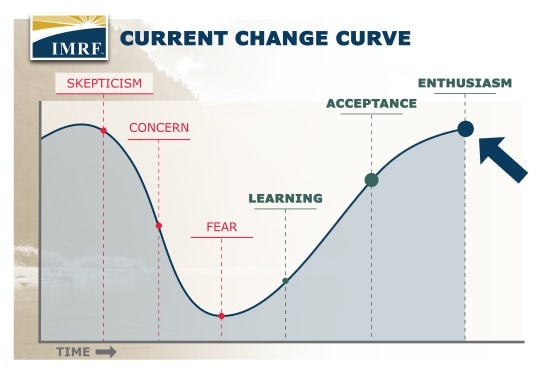
Along the Kübler-Ross Change Curve, the IMRF team has progressed out of the Fear stage, gone through Learning and Acceptance, and entered Enthusiasm (see Figure 2).
In a recent staff pulse survey, 100 percent of respondents marked “Agree” or “Strongly Agree” when they were asked if they continue to feel excited about the changes the Horizon Project will bring. Also, 100 percent of staff agreed or strongly agreed that they added value to the last few Horizon workshops they attended.
Reflecting on our progress to date, it is clear that a turning point in this project came when IMRF intentionally focused on the people side of the Horizon Project. By integrating modern OCM strategies, fund leaders helped team members progress more rapidly along their Kübler-Ross Change Curve and placed the organization in a position to successfully complete an organizationally transformative technology project.


