
June 2020
The fight for talent in the United States is expected to resume right where it paused when the COVID-19 pandemic hit. While it may be some time before the unemployment rate again sinks to 3.5 percent, for-profit companies will likely outcompete public sector organizations by using every arrow in their quiver to attract, retain and motivate top talent. Constraints on how quickly hiring decisions can be made and competing budget and policy priorities combine with low pay to make competing with private companies harder.
Still, all public and for-profit employers can anticipate transformations in the coming years. As reported in Mercer’s 2019 Global Talent Trends Study, four out of five executives believed their companies could manage the disruption. Despite this, only one in three executives rated their firms’ ability to mitigate the human capital risks that can derail change as very effective.
The good news for the public sector is that government entities have already cleared some of the biggest hurdles to building a workforce capable of handling transformation. Yet, Mercer’s study also revealed clear areas for improvement.
Awareness of Problems Has Grown Rapidly
Seventy-three percent of executives surveyed by Mercer in 2019 predicted a significant business disruption in the next three years. This was a major increase, as only 26 percent said the same thing the year before. Meanwhile, employees were looking for direction amid so much uncertainty. One in three workers said their organization lacked a climate of trust. Workers also expressed concern that AI and automation will replace their jobs.
Employees’ anxiety is understandable. In recent years, organizations have moved from anticipation to action in preparing for the future of work. But organizations risk bewildering people with too much change while ignoring the values people admire and inundating people with endless processes built around constant change.
What Does a Thriving Organization Look Like?
Consciously shaping the future of work should involve building a coherent sense of identity, sparking connections and using data to personalize the employee experience. Because human beings thrive on relationships, productivity depends on each individual being able to network and establish connections within and outside their organization. Employees identified by the Mercer survey as thriving due to prospering in the areas of health, wealth and career were twice as likely to describe their role as “relationship-focused” and their work environment as “collaborative.”
Top Talent Trends
In examining the differences among organizations—for example, how high-growth companies differ from those with moderate revenue growth, or how organizations beginning their digital transformation compare with those that are further along—Mercer’s study identified four trends among leading organizations.
Aligning Work to Future Value
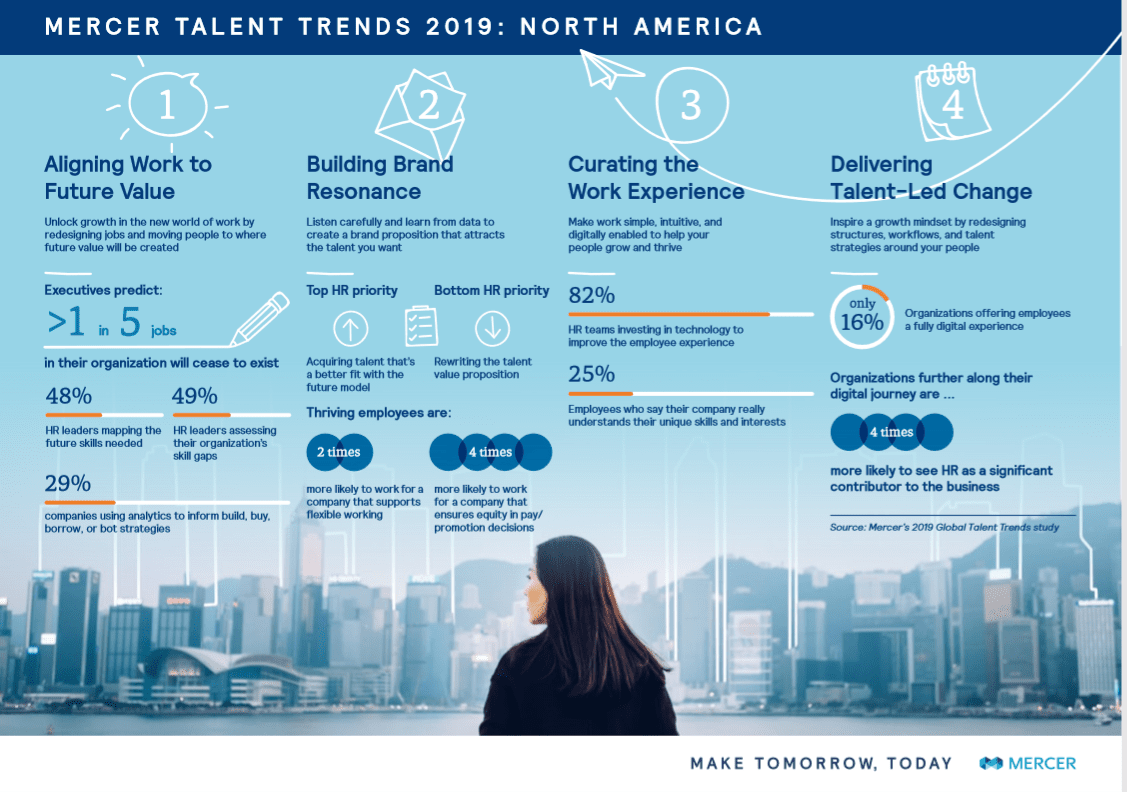
With AI and automation transforming the competitive landscape, 60 percent of surveyed companies planned to automate more work. Survey respondents from the C-suite named job redesign as the area of talent investment with the highest potential for delivering a return on investment. At the same time, 65 percent of employees asked for more clearly defined responsibilities.
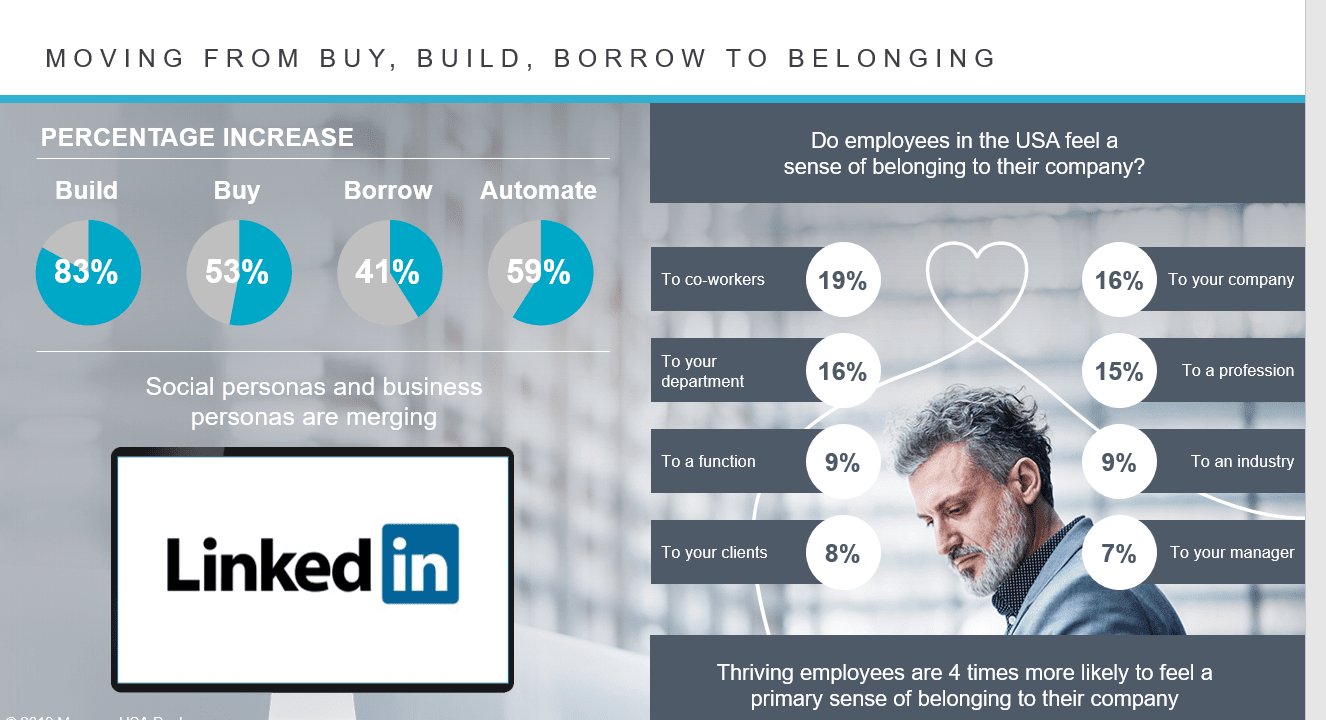
For human resources professionals, a principal challenge is to build an integrated people strategy, and this was an approach deployed four times more frequently at high-growth companies than at modest-growth ones. Talent analytics can deliver valuable insights into the impact of an organization’s buy, build, borrow and automate strategies; yet, only one-third of companies said they were using analytics.
HR must leverage the right talent analytics to inform decisions regarding the future size and shape of the organization’s workforce. Specifically, it is important to align jobs and people with where organizational leaders believe future value will be created.
Achieving such alignment enables a mechanism that rewards future-fit skills and behaviors. And this is where the public sector outperforms many private companies. Government entities have typically embodied a build culture, which is a positive attribute going forward, particularly when the competition for talent resumes in earnest.
Building Brand Resonance
Values matter to talent, and this is another area where public sector organizations are ahead of the game. The ways that an organization conducts business and upholds the values of its brand matter to employees and jobseekers. In a social, transparent world, lines are blurring between an organization’s brand and its talent value proposition (TVP).
Successful companies ensure that their brand resonates with all workforce segments. Mercer’s research confirmed this, with 68 percent of high-growth organizations differentiating their TVP to different groups, including contingent workers. Just 47 percent of modest-growth companies did this.
Public employers have long made a compelling case for their TVP by emphasizing their existence as mission-driven organizations. That has helped them attract talent despite offering below-market compensation. Now, the private sector is having to make the same brand adjustment to keep up.
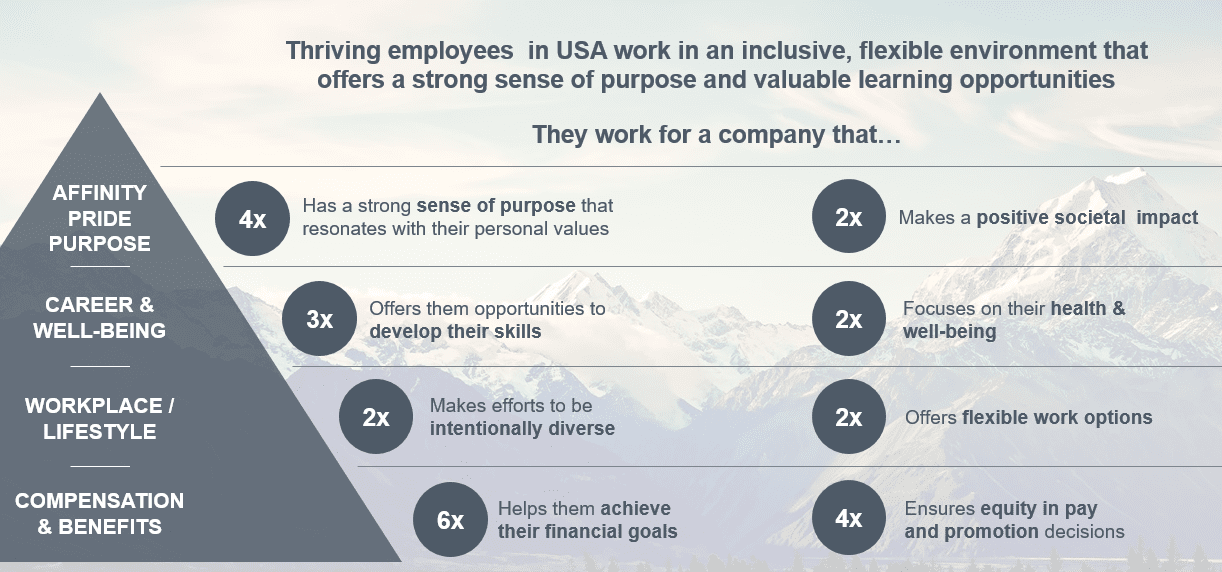
An organization’s total rewards philosophy is also an area where brand values can shine. Thriving employees were found to be four times more likely (78 percent versus 18 percent) to work for a company that ensured equity in pay and promotion decisions and twice as likely to work for a company that offered flexible work schedules.
Here, again, public employers may have an advantage over for-profit companies. Equity and flexibility have been central to the TVP of public sector organizations for decades.
Curating the Work Experience
Fostering an effective and relevant day-to-day work experience is essential for retaining top talent. According to Mercer’s research, thriving employees were three times more likely to work for an organization that enables quick decision-making and which provides the tools and resources employees need to do their job efficiently. Unfortunately, neither are presently hallmarks of public employers, but both are things many organizations are working on and slowly moving toward.
Offering personalized professional development is an area of opportunity for public sector employers, even if doing so is only possible within a particular department or unit and not across the entire organization. Confirming this, Mercer found employees asking for simplified professional development plans. More than half (56 percent) indicated that they want curated learning to help them evolve their skills and prepare for future jobs.
Last, how organizations use data and analytics to enable employees to make informed career choices is important. Technology should play a critical role. High-growth firms were twice as likely as moderate-growth firms to provide a fully digital experience for employees.
Delivering Talent-Led Change: Give HR a Prominent Role
Compared with earlier years, the employee experience rose dramatically on HR’s agenda in 2019 as more organizations recognized that employees have the same wants, needs and desires as customers. Building a better employee experience requires a mindset shift, and making the shift is critical to creating an environment in which people to thrive.
Organizations leading the way on this were focusing on the interaction between HR and the workforce. Among survey respondents, one-third indicted their organization was planning to invest in AI to enhance the employee experience and deliver talent insights.
To ensure talent is at the center of change, HR should have a voice in guiding an organization’s transformation. Mercer found that just two in five HR leaders participated in the idea-generation stage of transformation initiatives. This is concerning, given emerging human capital risks flagged by HR professionals.
By their survey responses, people in HR saw employee morale as a significant barrier to making changes stick. Employee attrition and a decline in employee trust were identified as specific problems.
For its part, HR needs to ensure that its function is strategic, lean and digital. Three-quarters of organizations in the Mercer study were still on a journey to deliver a digital employee experience, however, so there is a ways to go.
The Future of Talent in the Public Sector
Viewed all together, findings from Mercer’s 2019 Global Talent Trends Study point to the need for transformation efforts to focus more on people-centered design. The findings also constitute a call for better talent metrics to understand how people are experiencing and embracing change.
The public sector cannot elude the transformation happening in the world of work. Indeed, some of the most meaningful areas of transformation and affinity, such as being mission-driven and focusing on equity and flexibility, are ones where public employers have already evolved. Areas such as maximizing total rewards, fast decision-making and innovation will remain challenging for the public sector. But knowing where the gaps are will help public sector HR and business leaders focus their efforts in the coming years.


