
December 2021
There are innumerable accounts of employers terminating employees for committing a variety of offenses on social media. Reasons given for firings include posting provocative photos, hurling racist or homophobic slurs, and threatening violence.
Those fired employees then go looking for new jobs, and they may apply for a position at your organization. Understandably, recruiters and hiring managers will want to know who applicants are and whether a person they plan to hire will make the organization a bullseye for internet outrage.
To avoid claims of negligent hiring and other concerns, employers should consider implementing pre-offer online presence reviews. Being intentional and transparent with the screening process, as well as being consistent and nondiscriminatory in applying screening criteria, must be primary considerations.
Social Media Plays a Growing Role in Recruiting and Hiring
Recruiters use social media to search for candidates, and a 2018 CareerBuilder survey showed about 70 percent of employers screened candidates’ social media histories before making job offers. But when managers or recruiters search social media or run an internet search to screen candidates, it is unclear how many do so as part of a defined recruitment process rather than simply as a last-minute gut check.
Social media screenings are generally restricted to public posts. Many states have password protection laws that prohibit a prospective employer from demanding applicants share their social media passwords or requiring applicants to friend or mutually follow a recruiter, manager or organization.
However, no law prevents an employer from reviewing what a candidate shares publicly online or from using publicly available online information when making hiring decisions. Three restrictions are that an employer cannot use a candidate’s post to discriminate, should not use personal information that is irrelevant to the job to make a hiring decision, and must apply criteria for assessing posts consistently across all candidates.
Be Aware That Social Media Searches Can Be Discriminatory
Scouring the internet for information on candidates without following a defined process puts managers and recruiters at significant risk for purposefully or unconsciously factoring protected demographics and irrelevant information into their decisions. Viewing information through the lenses of implicit biases is always a problem. Plus, once someone sees a social media post, they cannot unsee or unknow it.
For example, a manager or recruiter who sees a woman’s announcement of her pregnancy on social media may infer she will soon need parental leave. That knowledge could trigger the manager to make an adverse selection decision because the manager worries about potential time off down the road. The manager might also harbor biases against pregnant workers, working parents or children.
This scenario also highlights how managers and recruiters can view men and women differently. How, for instance, would a man whose Instagram profile picture shows him doing a beer bong at a fraternity party be judged versus a woman doing the same thing? And what about a man showing his six kids on social media versus a woman showing her six kids?
Create a Defined Process to Review Candidates’ Online Presence
To minimize the influences of biases, employers should create and enforce rules for screening candidates’ social media posts and for relying on that information to make employment decisions. An essential part of the process must be identifying the types of conduct or behaviors that would disqualify a candidate for employment. Each reason should be accompanied by an explanation why the conduct or behavior is disqualifying and/or how it violates the organization’s rules, ethics or other expectations It is equally important that the process be followed consistently across the organization and with each candidate.
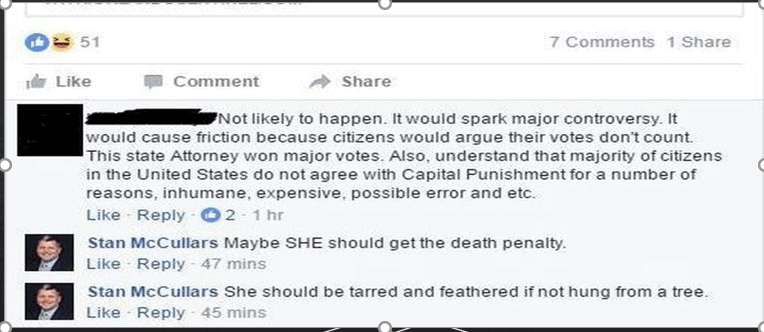
An example of an employee’s social media post that merited termination is shown in Figure 1. A Florida clerk’s office was inundated with complaints when one of its employees suggested in an online conversation that a Black state attorney should be hung from a tree. The comment was made in the context of recommendations for pursuing the death penalty against a defendant.
The clerk’s office terminated the employee, and the office prevailed in a subsequent lawsuit. That employee will not be returning to his former employer, but do you want the person working at your organization? What about his statements, if anything, would make him unemployable as a matter of policy?
Weigh Free Speech Rights
Government employers need to consider whether First Amendment protections apply to social media posts that raise concerns over a candidate’s suitability for hiring. In the case of the employee who worked at the clerk’s office, the public employer was able to demonstrate how because the comments going public disrupted the workplace, the interests of the public employer outweighed any First Amendment considerations. These cases are very fact-specific.
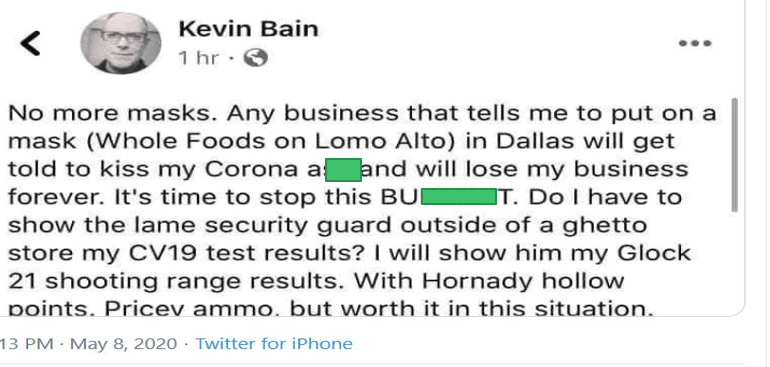
Consider the post shown in Figure 2. A private sector law firm bore the brunt of social media attacks when one of its employees vented about requiring face masks and testing during the COVID-19 pandemic. The firm terminated him for making what the law firm described as a violent threat.
Again, think about this person applying for a job with your organization. If your organization screens candidates’ social media accounts, are there policies that would preclude his employment?
List and Define Disqualifying Posts and Behaviors
Examples of online conduct and publicly available information employers have used to disqualify candidates include
- Posting provocative photos or images;
- Making negative comments about or disparaging other people because of characteristics such as race, gender, age, national origin, color, religion, gender identity, sexual orientation and disability;
- Making threats;
- Committing acts of violence;
- Disparaging a former employer;
- Portraying or describing personal use of illegal drugs; and
- Committing crimes.
Each organization needs to create its own list based on what the organization values. The group put in charge of spelling out disqualifying behaviors or statements must keep in mind that individuals should not be denied employment based on their political views or comments that may be controversial but which are not discriminatory, illegal or in violation of the organization’s policies, values, code of ethics or code of conduct.
Do Not Let Hiring Managers Perform Social Media Screenings
Hiring managers should not be the ones who conduct screenings. Making sure this does not happen is important because managers are prone to using all the information they gather even when information is not relevant or legal to use when deciding whether to hire a candidate. Everyone possesses implicit and unconscious biases, so even managers with the best intentions may err when making decisions.
For these reasons, the organization should have either a committee or a third party conduct social media searches on candidates. When a third party such as a background search firm is used, the organization will need to strictly comply with the Fair Credit Reporting Act. If the organization does the screening in house, FCRA rules will not apply.
Employers Can Rescind a Job Offer
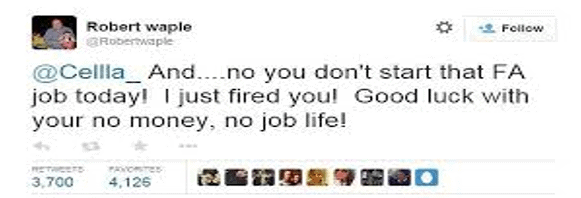
An example of a social media post that justified rescinding a job offer before an employee even started working is shown in Figure 3. The cleaned-up version is that the newly hired person expressed her displeasure at the prospect of showing up for work on her
first day.

The woman’s prospective employer saw her post and let her know, as shown in Figure 4, she was no longer welcome.
Just as an employer can legally deny employment due to conduct or behaviors demonstrated on social media, a prospective employer can equally rescind an offer of employment.


