
July 2022

The Great Resignation or Big Quit is disrupting organizations worldwide. Looking just at the United States, 4.4 million employees quit their jobs in April 2022, according to the U.S. Bureau of Labor Statistics.
The competition to attract top talent is also getting fiercer. A shortage of professionals in technology, accounting, engineering and other specialized fields has been brewing for more than a decade as many baby boomers reach retirement age while entry-level and midcareer professionals fall short of filling the gaps.
Understanding why midcareer employees quit tells you what problems they are trying to solve and gives you valuable information for retaining and attracting the best candidates. Hinge Research Institute’s recently published report, “Navigating the Mid-Career Talent Crisis,” reveals that 30 percent of midcareer professionals between ages 30 and 45 quit their jobs over the past year. A third of those left without having another job lined up.
For more than 70 percent of respondents to the survey on which the Hinge Research Institute report is based, frustration with their boss and organizational culture were the top two reasons for quitting. This news may surprise senior executives who don’t see or fail to recognize the effects leadership and culture have on their employees. Still, the simple fact is that people don’t just leave organizations; they leave leaders and the cultures leaders create.
Understand Your Midcareer Employees’ Needs
Midcareer employees often possess the skills organizations rely on, especially as most struggle to adapt to rapid market changes and disruptions. Yet, midcareer professionals find themselves in a precarious position. These individuals are accountable for implementing senior management’s strategies and goals. They also carry the burden of creating a supportive, visionary and fun work environment for their teams, sometimes in a remote or hybrid work environment.
The Hinge Research Institute study showed that only 48 percent of midcareer respondents are satisfied with their current jobs. Many of these individuals are now passively or actively looking for new opportunities—especially those that promise to involve less pressure.
Factors driving midcareer employees to quit their jobs are shown in the accompanying chart. Topping the list:
- 76 percent were frustrated with leadership/management
at their old job. - 72 percent desired a better culture.
- 52 percent wanted a better work-life balance.
- 48 percent felt their work was unfulfilling. (See Figure 1.)
Figure 1: Reasons Midcareer Employees Gave for Switching or Quitting Jobs
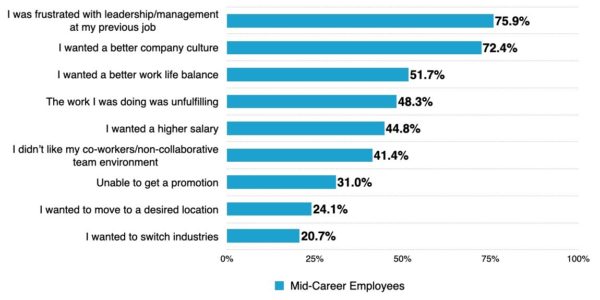
Many organizations believe that employees leave for larger salaries and that there is nothing they can do to compete. However, the study illustrated that only 45 percent of survey respondents left their jobs for the chance to make more money.
Take a Long, Hard Look at Your Organization’s Culture
What are the signs of a toxic culture? Many employees working in toxic cultures feel disrespected and mistreated due to their race and gender. They do not believe they can be their authentic selves at work and are uncomfortable sharing these thoughts with leadership.
The Hinge Research Institute study also found that midcareer employees at larger organizations were more likely to feel unappreciated or overlooked. Moreover, a toxic culture hits employees hardest in remote or hybrid working environments, leaving individuals isolated and with no one to talk to.
Build an Ideal Employee Experience
What programs and initiatives do midcareer employees value? Mental health days and in-person social events were at the top of their lists. Do not underestimate the power of this type of socialization to enhance communication and loyalty. Two years into the pandemic, these individuals were itching for in-person events to catch up with peers and friends.
These employees are also the chief advocates for mental health days; diversity, equity and inclusion programs; and employee recognition. This is in stark contrast with only 8.8 percent of senior executives in the study who believed in the value of mental health days.
Mental health significantly impacts an employee’s focus, memory and ability to connect with teammates. Long-term employee stress leads to a lack of productivity, directly affecting the organization’s bottom line.
If you have the budget, champion mental health, DEI and employee recognition initiatives in your organization. These programs have been proven to help with talent retention and attraction.
Regardless of all else, it is essential to focus on open communication between employees and leadership, especially with remote teams. In the Hinge Research Institute study, 94 percent of respondents did not feel comfortable sharing thoughts with leadership. This can be an easy fix for your organization. Build new channels for safe thought-sharing. And be sure to communicate regularly with your staff so they feel a part of your organization.
Ask yourself one more question: When was the last time your senior leadership received management training? Most executives move into those positions based on their experience and accomplishments, not their leadership and communication skills. Consider whether investing in leadership assessments and training would deliver significant returns. It stands to reason that such investments will not break the bank.
A Final Thought
In today’s competitive marketplace where the labor supply continues to be tight, the Great Resignation is quickly becoming a Great Reckoning for some leaders.
This could not have happened at a worse time for many organizations. After the last two years of unpredictability and stress, midcareer employees find themselves more sensitive to the challenges of their work and personal lives. Their departure leaves organizations short-staffed during critical times. It also robs organizations of experienced future leaders.
The ball is in your court. Your actions today can help you navigate the midcareer crisis. Do not underestimate the benefits of showing employees that you are listening. Reimagining your culture, adding perks and improving communications channels will help attract and keep top talent.


