
July 2022
The Key to Building an Engaged Workforce

With the Great Resignation being a top-of-mind issue, many organizations are looking for ways to boost retention. The time and money spent hiring and onboarding new employees is significant, and institutional knowledge leaves with each departing employee.
Creating a culture of inclusion and belonging, as well as making employees feel heard and seen, offers a way to improve retention. To accomplish this, management must focus on increasing diversity, equity, inclusion and accessibility (DEIA). Management must also keep lines of communication open with all employees, particularly those who might usually fall below the radar of managers and executives.
Establishing employee resource groups (ERGs) is an increasingly common solution to meeting the challenge of ensuring employees of all backgrounds are heard. Let’s look at what ERGs are, how they benefit employees and employers, and what management must do to ensure ERGs produce those benefits.
What Is an Employee Resource Group?
ERGs evolved from affinity groups that formed at workplaces during the 1960s. Individuals who shared a common identity, interest or background came together to provide each other support in the face of racial tensions and other forms of discrimination.
Current ERGs operate on a similar model of grassroots involvement, and participation is voluntary. Membership in these forums should be open to employees at all levels so everyone is given a seat at the table. By definition, an ERG creates an avenue for communication that is structurally separate from the organizational chart.
Although ERGs can vary in structure and aim, successful groups share these elements:
- A common goal or mission statement that ties members of the group together;
- Voluntary grassroots support from employees at all levels;
- Leadership by employees instead of managers or executives; and
- A member of management who sponsors the group, listens to ideas and brings employees’ insights and innovative suggestions to organizational leadership.
With these elements in place, ERG leaders can determine the programming that best fits the organization. Some groups may hold monthly meetings to keep a conversation going. Others may prefer quarterly check-ins and informal exchanges of information in between scheduled meetings.
Presently, 90 percent of Fortune 500 companies have some form of ERG. The groups may be referred to as cohorts, working groups or some other name, but each will generally be formed around a common identity or interest. It should be emphasized again, however, that ERG membership should be open to all employees. Allyship and understanding are important components for building a network of support.
What Are the Benefits of an ERG?
ERGs go further than support groups by increasing communication across ranks. Employees at all levels of the organization share their experiences and learn how to support each other. (See Table 1.)
Table 1: How Employee Resource Groups Benefits Employees and Employers
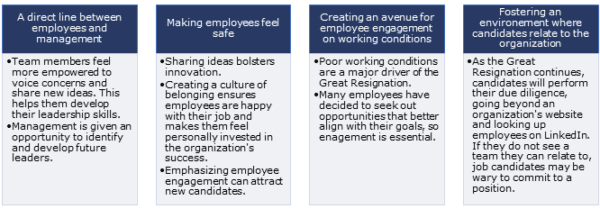
ERGs also increase employee visibility and reduce blind spots for leadership. For example, an executive who attends ERG meetings may get to know employees they would not normally interact with on a day-to-day basis.
Maintaining an Open Dialogue
This is an ongoing effort, and leadership should play an active role in reinforcing the importance of communication even as managers and executives let employees drive the conversation in ERGs. In doing so, management should keep the following best practices in mind:
- Be receptive and responsive to new ideas that arise from these groups. ERGs are driven by grassroots support from employees. If leadership does not listen, efforts to make positive changes within the organization will die out. Some concerns raised by ERGs can only be resolved by launching new initiatives or changing policies. Management should step up in those instances.
- Realize that ERGs may evolve and change to meet the needs of employees. For instance, a BIPOC working group may split into ERGs that specifically support Black employees, AAPI employees, Latino employees and Indigenous employees as the organization’s workforce grows and becomes more diverse.
Ultimately, establishing ERGs fosters employee engagement. Engaged employees are passionate about their work, invested in the organization’s success and more likely to speak out when something is amiss. Keeping lines of communication open to hear and act on what employees share is vital to creating a culture that embraces DEIA and belonging.


