
September 2026
(All photos courtesy of Adam Bacher)
As a product marketing manager at Google, Tucker Bryant partnered with product teams to define, position and launch Google Assistant product features in emerging markets.
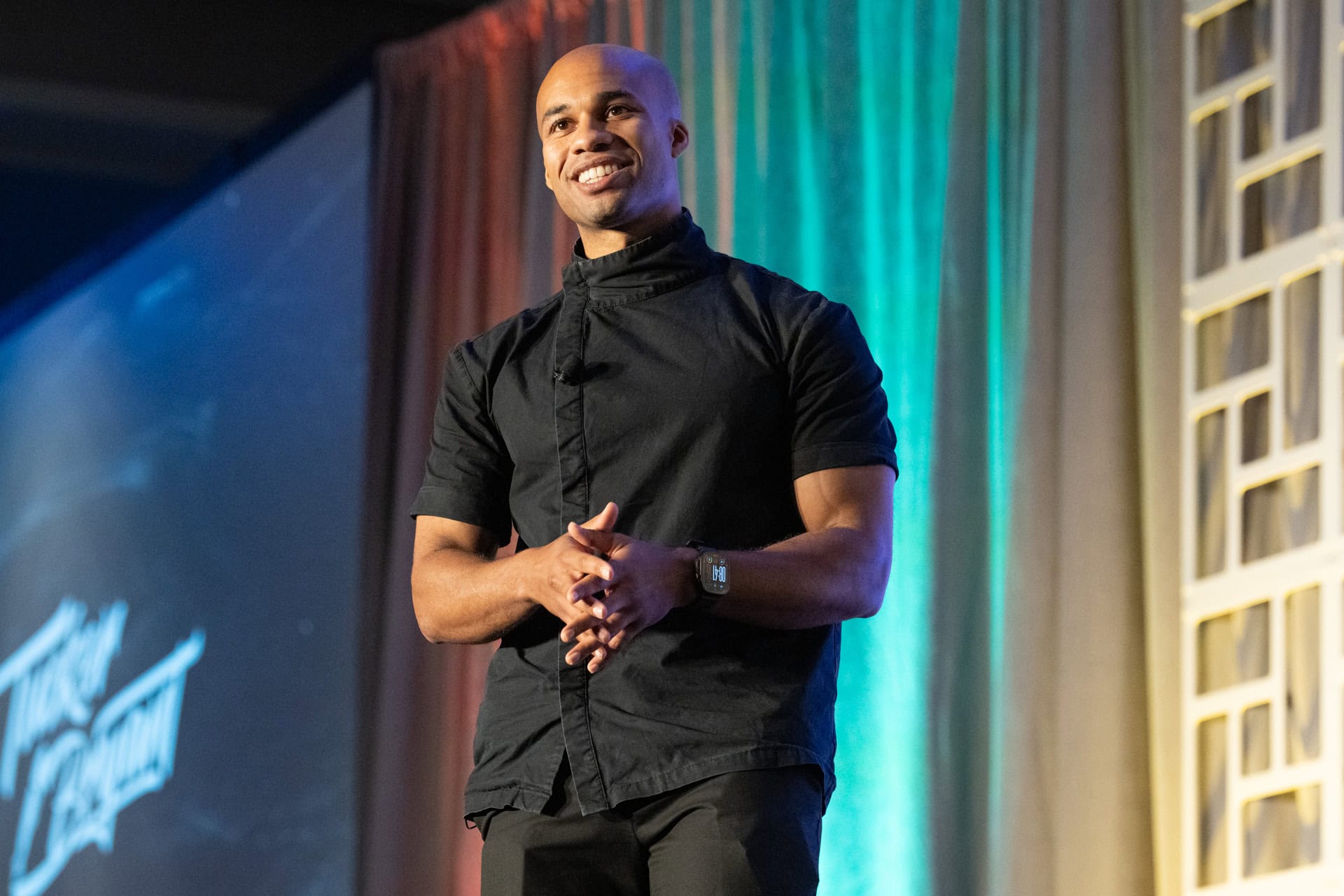
Bryant, who left the tech giant in 2021, is also an artist and poet. He brought his unique background as a veteran of Silicon Valley and the creative arts to PSHRA26 at the Hilton Portland Downtown, where he delivered the Day Two keynote.
In “Do Different Things Differently,” Bryant shared how the type of inspired innovation and creative thinking he brought to his corporate roles and to his work as an artist can be brought to public sector HR.
Bryant is based in San Francisco. To provide an example of how to do different things differently, he shared a recent experience trying to pen a poem offering his fellow Golden City residents solace on rainy days.
“Rainy days give us perspective,” he said, recalling his attempt hitting a creative wall as he reached for the language he needed to complete his uplifting poem.
“The problem,” he said, “wasn’t the words. The problem was that the people who need the poem the most won’t be looking at a book or paper. They’ll be looking at pavement as they, say, walk to work.”
The solution came in the form of a spray bottle of Never Wet, a solution used to repel water from surfaces. With his poem finished, he took it to a professional who stenciled the words on a sidewalk in his neighborhood, along with a generous spraying of Never Wet.

The next time it rained, Bryant poured the Never Wet on the words stenciled on the sidewalk. The poem appeared:
Welcome the downpour
Some revelations
Only appear
Beneath a sobbing sky
“Here’s what I want you to think about,” Bryant told the conference attendees packing the hotel’s Grand Ballroom.
“The poem didn’t become better by busting out my thesaurus and working on the words. It was finding and using different tools to make it better.”
Leaning into Limitations
As a public speaker at events like PSHRA’s national conference, Bryant said he often encounters workplace leaders who say they “aren’t free to think outside the box” and demonstrate that type of creativity.
“But here’s the thing,” he said. “Thinking outside the box doesn’t necessarily mean being creative.”
There’s always going to be some kind of “box,” such as workplace regulations, budgetary constraints and so on, Bryant said.
As such, Bryant challenged the public sector HR leaders in the audience to think inside the box, and to embrace limitations as a launching point for innovative solutions on the job.
“There’s so much to be gained,” he said, “by seeing our constraints as creative ways to navigate our challenges.”
Bryant recounted another recent art project to illustrate his point.
“I was thinking about the technology shaping our world, and I got this dumb idea that went something like this: what if there were a chatbot that was as futuristic as other chatbots, but it was really … just some dude.”
So, Bryant bought a web domain—www.chatTJB.org—and shared it with friends. His friends would feed him random, mundane prompts. One, for example, asked what an illustration of a common housecat would look like. Bryant would provide responses that, by his own admission, weren’t exactly useful. And they would have a laugh.

Soon, the prompts he received started to come from beyond his circle of friends. As he started spending more time on his fake chatbot, he decided he wanted to buy billboard space to promote it.
He ultimately found an available billboard in his price range; a billboard that he says was in maybe the worst, least visible spot in San Francisco.
Touting his chatbot as “the leading chat interface powered by AI,” Bryant made “the most financially irresponsible decision of my life” and sprung for the billboard space. For one month. In that time, the project took off in a way that he never expected.
(It’s worth noting that AI* included an asterisk on the billboard, acknowledging that the interface was actually powered by an “average individual,” and not artificial intelligence.)
The billboard’s “trash” location prevented it from being readable for passersby on the highway, he said. But it did catch the attention of at least one X user, who found it funny enough to capture a screenshot and share it on their account. Things snowballed from there.
The screenshot of the billboard wound up getting thousands of views on social media, he said. Before long, the viral shot attracted national media outlets: The San Francisco Chronicle. USA Today, which went with the headline, “It’s ChatGPT, except it’s just one guy and he gives really bad advice.”
The increased attention brought a wider range and much greater volume of questions for Bryant and his bogus chatbot. Some of them were serious. For example, one user asked if it was ok to not be “totally relaxed” on their honeymoon.
He estimated that he was getting around 5,000 prompts an hour, which put the next constraint on his project. Bryant simply didn’t have the time—never mind the expertise—to handle all the questions thrown his way.
So, he looked for help. He searched for volunteers to help. He was shocked to see more than 15,000 people apply to be “Average Individuals helping strangers out, too.”
As the project’s scope quickly ballooned, Bryant decided to pause it and look for sponsorship or operating partner support. (The billboard has come down as well, by the way.)
Bryant’s little AI project that became much bigger holds a valuable lesson in leaning into limitations to iterate and improve, he told the PSHRA26 audience.
“What if your constraints fueled your ideas? We all have limited resources. We all have regulations to deal with, we all have budgets. How can all of this help you think about really bringing the smallest thing to life?”
The public sector HR leaders attending PSHRA26 were there “because of your high standards. But those high standards can also hold you back when it’s time to chase an idea for which there is no playbook,” Bryant continued.
“Instead of always aiming for a masterpiece, make peace with the idea of aiming for the trash can. Just getting an idea on paper is the most powerful thing we can do to get started toward improving it.”


